

More about: 12 Best Paintings at the Uffizi Gallery
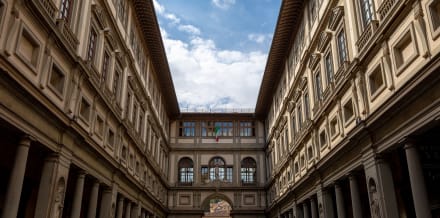
The Uffizi Gallery is a must-see. It is the most visited museum in Florence, as well as in Italy in general, and houses some of the world's most important works of art, such as Botticelli's 'La Primavera' and 'The Birth of Venus', Raphael's 'Madonna of the Goldfinch', Michelangelo's 'Tondo Doni', Filippo Lippi's 'Madonna and Child with Two Angels', Giotto's 'La Maestà di Ognissanti', Caravaggio's 'Bacchus' and Piero della Francesca's 'Portrait of the Dukes of Urbino', among others. Would you like to know all the works you can see on your visit? Keep reading.
And if you would like additional information about the art gallery, check out the post on tickets to the Uffizi Gallery. You can also find other suggestions for your trip to the capital of Tuscany in the article on what to see and do in Florence.
1. Botticelli's 'La Primavera'

'La Primavera' is one of Sandro Botticelli's masterpieces. It was painted between 1477 and 1482 at the height of the Italian Renaissance and is an allegory of spring. This work, which measures 2.03 x 3.14 metres, was commissioned by Lorenzo di Pierfrancesco de Medici.
There are different interpretations of this key painting in Botticelli's career, which stands out for the elegance of its characters and the impeccable use of colour. However, most agree that the central figure is Venus, representing harmony and balance between nature and spiritual values (on the left of the painting) and civilisation and material values (on the right). A fascinating work.
- This work is located in... rooms 10/14.
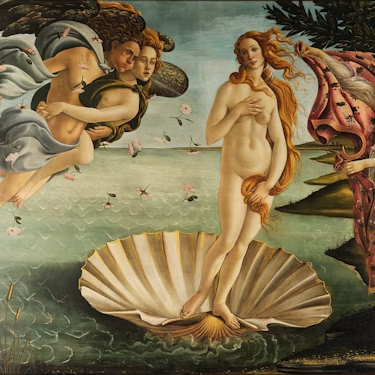
2. Botticelli's 'The Birth of Venus'

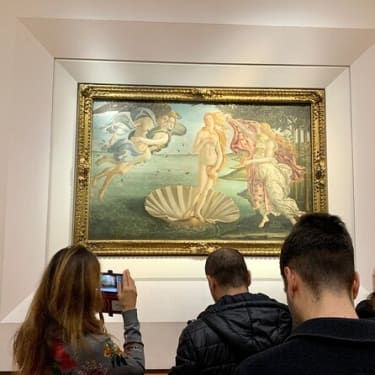
Painted between 1482 and 1485, 'The Birth of Venus' is another of Botticelli's great works . It stands out for its large size, 278.5 cm by 172.5 cm, and is one of the first examples of painting on canvas in the Tuscany region. It is characterised by its technique, as well as by the quality of the materials used, among which alabaster powder stands out.
This work has various meanings and shows Venus naked in a shell on the seashore in the centre of the painting as an allegory of the birth of love, as well as spiritual beauty. To her left, the winds blow flowers and to her right, a servant is about to cover her with a cloth.
- This work is located in... rooms 10/14.
3. Michelangelo's 'Tondo Doni'

Painted by Michelangelo after his first stay in Rome, the Tondo Doni or Holy Family dates from the same period as David, between 1506 and 1508, and is considered one of the great works of 16th-century Italian art, as well as one of the artist's few paintings alongside the frescoes in the Sistine Chapel. It was commissioned by the banker Agnolo Doni and measures 120 cm by 120 cm.
In an extraordinary wooden frame carved by Michelangelo himself, the work shows Mary, Joseph and the Child, with a series of nude figures in the background. This painting marks a turning point in history, as it laid the foundations for the Mannerist style, which would later be widely used by great artists and which advocates unnatural postures that give the work its characteristic movement. This strange position can be seen in the figure of Mary.
- This work is located in... room 35.
4. 'The Portrait of the Duke and Duchess of Urbino' by Piero della Francesca

The diptych 'Portrait of the Duke and Duchess of Urbino' was painted by Piero della Francesca between 1465 and 1472 and is one of the major works of the Italian Renaissance.
It depicts the dukes and spouses Federigo da Montefeltro and Battista Sforza in profile, as was customary in classical times, although the choice of this angle was more out of necessity, as Federigo da Montefeltro had lost his right eye in a tournament. In the background of the paintings, a large and deep landscape extends, reflecting the power of the Court. One of the curiosities of this work is that it is also painted on the back.
- This work is located in... Room 8.
5. 'The Madonna of the Goldfinch' by Raphael

'The Madonna of the Goldfinch' is one of Raphael's key works, showcasing the characteristics that define his painting: the sweet faces of the figures, the magnificent use of colour, the intimacy of the characters and a naturalistic representation of the landscape. In addition, the painter was greatly influenced by Leonardo da Vinci, from whom he adopted some of the characteristics of his painting, such as soft lighting, dialogue between the protagonists, and the pyramidal arrangement of the figures.
This work, measuring 107 cm by 77 cm, had been badly damaged since the 16th century and was restored on several occasions, but it was not until the last restoration in 2008 that it reached its full splendour.
- This work is located in... room 66.
6. 'The Virgin and Child with Two Angels' by Filippo Lippi

Painted around 1465 by Filippo Lippi, 'The Virgin and Child with Two Angels' is one of the most popular works of the Italian Renaissance and has a curious history. Lippi was a Carmelite monk who fell in love with the nun Lucrezia Buti. They had a secret romance until they renounced their religious life and had children, including Filippino, a famous painter and friend of Botticelli.
In 'The Virgin and Child with Two Angels', measuring 100 cm by 71 cm, the Virgin Mary is depicted with an elegant hairstyle decorated with a veil and pearls. She is shown in profile, praying in front of the child, who is held by two angels. Behind them is a landscape inspired by Flemish-style paintings. The peculiarity of this work is that many interpret the Virgin's face as a portrait of Lucrezia.
- This work is located in... Room 8.
7. Titian's 'Venus of Urbino'

'Venus of Urbino' is a work by Titian, dating from 1538 and commissioned by the Duke of Urbino, Guidobaldo II della Rovere, as a gift for his wife. Identified by many as an allegory of marriage, it stands out above all for its sensuality, although it has other significant features such as eroticism, motherhood and fidelity.
In this painting, measuring 1.19 m by 1.65 m, Venus, the goddess of love, is depicted in a sensual and erotic manner, appealing to the viewer. At her feet is a dog, symbolising marital fidelity. In the background, a maid looks at a girl searching through a drawer, symbolising motherhood. It stands out for its excellent use of colour and contrasts.
- This work is located in... room 83.
8. 'Bacchus' by Caravaggio

Caravaggio marked a turning point in the history of art. His painting was characterised by the use of warm colours, as well as by its realism and the representation of humble characters.
Painted at the end of the 16th century, 'Bacchus', an oil on panel measuring 98 cm by 84 cm, was a gift from Cardinal del Monte to the Grand Duke of Tuscany, Ferdinando I. In this painting, Bacchus is depicted as a humble young man from the village who reflects humanity. He holds a glass of wine in his left hand, notable for its transparency, and there are other common objects such as a basket of fruit.
- This work is located in... room 90.
9. Giotto's 'La Maestà di Ognissanti'

Giotto revolutionised the history of painting and the way men were represented, becoming one of the main architects of the Renaissance. 'La Maestà di Ognissanti' is a large altarpiece, measuring 204 cm by 325 cm, which he created for the Ognissanti Church in Florence around 1310. Mary is seated on a throne holding the child, and angels are positioned in the foreground. The space is very well defined, and the folds of the clothing define the figures in the scene.
- This work is located in... Room 2.
10. 'Altarpiece of Saint Lucia de Magnoli' by Domenico Veneziano

Domenico Veneziano's work was created between 1445 and 1447 and depicts the Virgin Mary with the child in the centre. Next to her are St. Francis and St. John the Baptist on the left and St. Zenobius on the right. The altarpiece is notable for being probably the oldest without a gold background and rectangular in shape, as well as for its bright colours. The use of bright light as a fundamental element entering from the upper right edge is also noteworthy.
- This work is located in... Room 7.
11. 'Judith Beheading Holofernes' by Artemisia Gentileschi

The first female member of the Accademia di Arti del Disegno in Florence, Artemisia Gentileschi was a renowned and progressive 17th-century Italian painter. Her paintings are characterised by the depiction of strong women. Specifically, in 'Judith Beheading Holofernes', the biblical heroine is depicted beheading her enemy, the Assyrian leader Holofernes.
- This work is located in... room 90.
12. 'The Adoration of the Magi' by Gentile da Fabriano
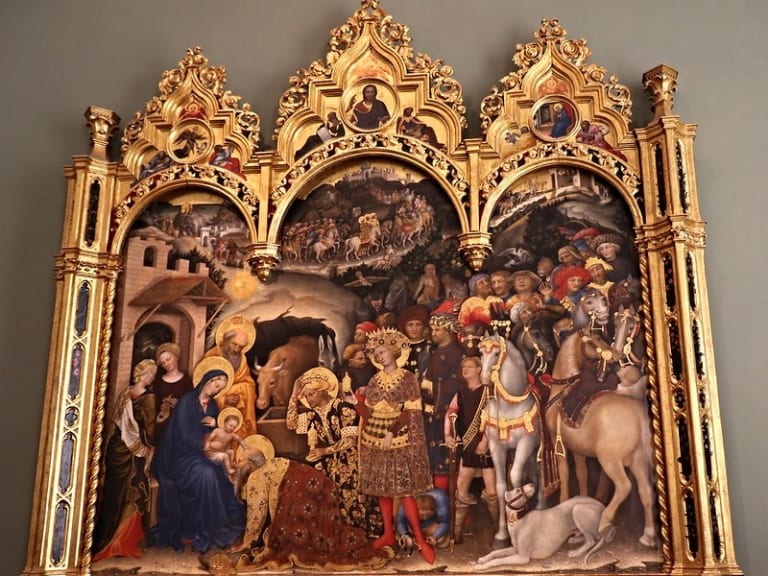
Also known as Pala Strozzi, this large altarpiece with a carved wooden frame dates from 1423 and is by Gentile da Fabriano. Commissioned by Palla Strozzi, it is one of the paintings in the International Gothic style, characterised by sophisticated forms, refined clothing and courteous poses. This work depicts the procession of the Three Kings, behind whom the portrait of Palla Strozzi can be seen.
- This work is located in... Room 7.
Recommendations for seeing the best works in the Uffizi Gallery without the crowds

When visiting the Uffizi Gallery, keep the following recommendations in mind to make your visit as enjoyable as possible:
- Buy your ticket in advance: The Uffizi Gallery is the most visited museum in Florence. It receives a large number of visitors every day, so it is important to book your ticket in advance to avoid long queues and wasting unnecessary time at the ticket office. You can also purchase a ticket with priority access. The cheapest tickets for the Uffizi Gallery start at €30 on Hellotickets.
- Check the map: Before starting your visit, it is advisable to check the map to see where the works that interest you most are located and start your tour in that area.
- Go first thing in the morning: Due to the large number of visitors who come to the Uffizi Gallery every day, it is best to go first thing in the morning so that you can see the art gallery in the most peaceful and comfortable way possible.
And after your visit to the Uffizi Gallery, don't hesitate to visit the Accademia Gallery. I also recommend that you read the post on the best museums in Florence and create the best itinerary for your trip.