







More about: 11 Best Artworks of the MoMa New York
The Museum of Modern Art (MoMa) is undoubtedly the most important museum in the world for modern art. But with a collection of almost 200,000 pieces, we run the risk of getting lost and ending the visit without having seen the most important works. Below, I detail the essential works so that you can make the most of your visit.
It is difficult to decide which are the best works. To do so, I recommend that you check the MoMa map before starting your tour to see which floor has the most works that interest you. To make your visit easier, I can tell you that the most popular paintings at MoMa are on the fourth and fifth floors.

The Museum of Modern Art (MoMA) Tickets
Buy your tickets and discover the masterpieces of MoMA
Some of the most iconic works in art history await you in its galleries.
To ensure you don't miss any of these works of art and get the most out of your visit, purchase your MoMa tickets in advance. In addition to avoiding long queues, this will allow you to better plan your tour and focus on enjoying the museum's most iconic pieces, such as Van Gogh's The Starry Night or Picasso's Les Demoiselles d'Avignon.
Remember that MoMa also offers access to temporary exhibitions featuring the most innovative contemporary artists. When you purchase your tickets, you can enjoy a complete experience that combines classic masterpieces with the latest trends in art.
-
Recommended if... you want to enjoy iconic masterpieces and discover the best of modern art in one place.
1. Starry Night, Van Gogh

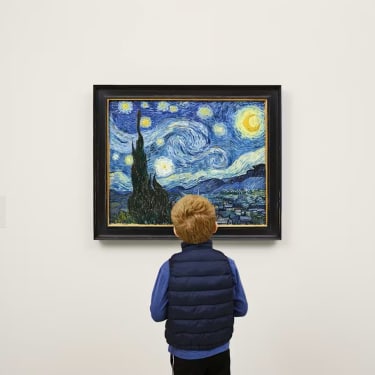
With your ticket to MoMa, you will have the opportunity to see The Starry Night, considered Van Gogh's masterpiece. It has been part of MoMa's permanent collection since 1941 and was acquired through the Lillie P. Bliss Bequest.
Starry Night is an oil on canvas painting and was painted by Van Gogh in a studio on the ground floor of the Saint-Paul-de-Mausole asylum. The view has been identified as that from his bedroom window, and he captured it in the painting at different times of the day: sunrise, moonrise, on sunny, cloudy, windy and rainy days.
- This work is located on the fifth floor and is the most visited work in the museum.
2. The Persistence of Memory, Salvador Dalí

The Persistence of Memory by Spanish painter Salvador Dalí is also known as The Soft Watches or The Melting Watches, and is another of MoMa's key works.
This oil on canvas, which dates from 1931 and has been in MoMa since 1934, is a surrealist painting that represents a subjective vision of temporality. The technique is precise and the drawing academic, with pure lines. An interesting fact: Dalí acknowledged that he was inspired by Camembert cheese when creating the painting.
- This work is located on the fifth floor of MoMA.
3. Les Demoiselles d'Avignon, Pablo Picasso
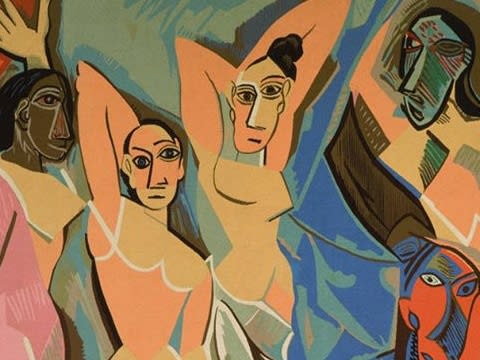
Les Demoiselles d'Avignon was painted by Pablo Picasso in 1907 and depicts, in Cubist style, five prostitutes from Barcelona's Carrer d'Avinyó.
This painting was first exhibited at the Galerie d'Antin (Paris) in 1916. Picasso subsequently kept it in his studio until the early 1920s, when it was acquired by Jacques Doucet and exhibited at the Petit Palais Museum in 1925. It was later purchased by MoMA and is now one of the favourite pieces in the collection.
- This work is located on the fifth floor of MoMA.
4. Campbell's Soup Can, Andy Warhol

Campbell's Soup Can is a work of art produced by American artist Andy Warhol in 1962. It is also known under the title 32 Campbell's Soup Cans.
This work was Warhol's first solo exhibition in an art gallery as a professional artist. The work consists of 32 canvases and shows each of the varieties of canned soup that the company offered at that time. An exponent of pop art, it has become a world-famous image, being printed on numerous merchandising items.
- This work is located on the fourth floor of MoMa.
5. Water Lilies, Claude Monet

Water Lilies, by the impressionist Claude Monet, belongs to a series of paintings that the painter created in the French village of Giverny at the end of his life.
These canvases are characterised not only by their large format, but also by the fact that neither the shore of the lake where the water lilies lie nor the horizon line can be distinguished in them. In fact, it is a familiar painting precisely because of this blurring of the contours.
- This work is located on the fifth floor of MoMa.
6. The Lovers, René Magritte

René Magritte'sThe Lovers is located on the fifth floor of MoMa, in the Richard S. Zeisler collection.
The Lovers dates from 1928 and is the first work in a series of four variations. It is a disturbing image that leaves no visitor indifferent. There are different interpretations of its meaning. Some say that it shows a terrible memory of the painter, as when he was a teenager he witnessed his mother's body being pulled from the Sambre River with her wet shirt wrapped around her head.
In fact, it is very common in Magritte's works for characters to appear with their faces covered by a veil. It is also said that it may be a metaphor for desire, impossible love, forbidden love or past loves.
- This work is normallylocated on the 5th floor**,** but it is not always on permanent display.
7. Gas Station, Edward Hopper
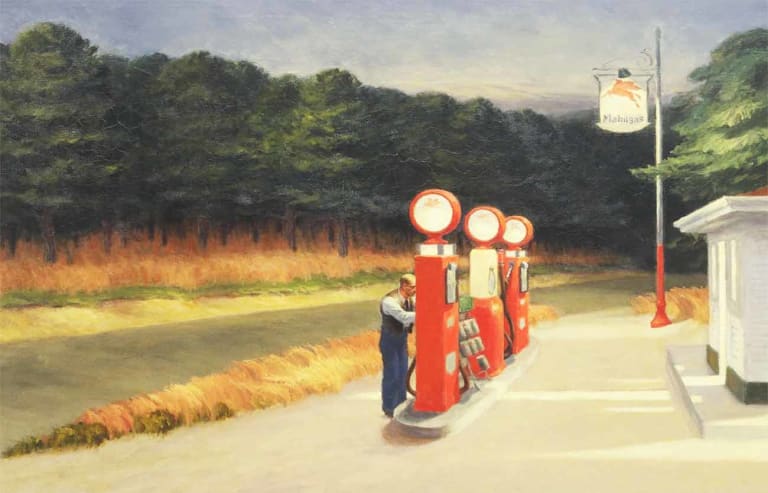
Gas Station, by Edward Hopper, is a series of several petrol stations seen by the artist, which you can also see during your visit to MoMa.
The American painter was one of the leading representatives of 20th-century realism. However, his paintings were not well received by either the public or critics at the time, and he was forced to work as an illustrator to make a living.
It was after his death that Hopper began to be recognised as one of the great masters of 20th-century art. Today, his work has become an icon of modern life and society.
- This work can be found on the fifth floor of MoMa.
8. Dutch Interior, Joan Miró

Dutch Interior is a series of three paintings created by Joan Miró in 1928 after a trip to Belgium and the Netherlands, where he was inspired by 17th-century Dutch painting.
It is one of the most representative works in Joan Miró's oeuvre and is characterised by a search for the essential and a refinement of the expressive vocabulary that characterised his earlier works.
- This work is normallylocated on the 5th floor**,** but it is exhibited on a rotating basis because the oil painting is fragile.
9. Self-Portrait with Cropped Hair, Frida Kahlo
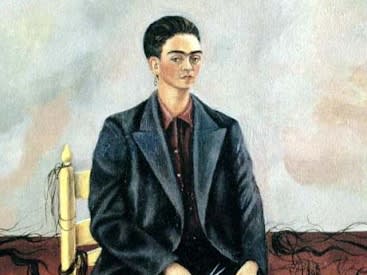
Self-Portrait with Cropped Hair is Frida Kahlo's first self-portrait after her divorce from Diego Rivera.
The self-portrait represents the change in her life after the divorce. Kahlo is seated in the centre of the work. She appears in a large, dark men's suit. Self-Portrait with Cropped Hair was Kahlo's first work at MoMa.
- This work is located on the fifth floor.
10. One: Number 31, Jackson Pollock
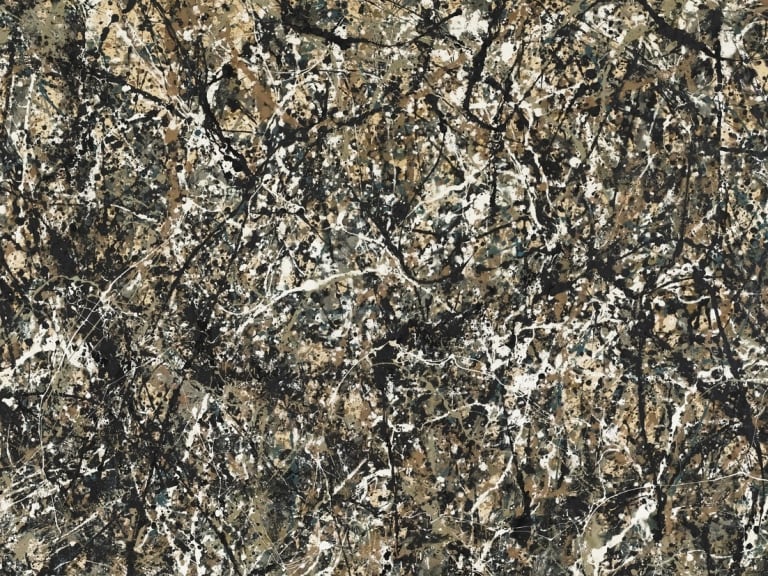
One: Number 31 by Jackson Pollock is one of the most outstanding examples of his "drip" technique: an abstract expressionist drip painting style, in which he dripped, spilled or threw paint onto a canvas spread out on the floor.
This painting, which dates from 1950, is one of Pollock's largest paintings and can be admired if you book your ticket to the MoMa.
- This work is located on the fourth floor.
11. Bicycle Wheel, Marcel Duchamp
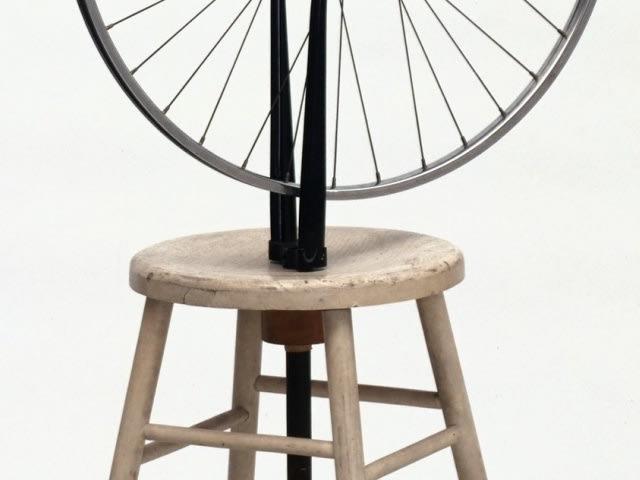
Bicycle Wheel predates Marcel Duchamp's use of the word "readymade," a term he coined after moving from Paris to New York in 1915.
This work, which represents the first example of this kind of revolutionary artwork, is located on the fifth floor and is considered the first kinetic sculpture. The artist denied that his invention had any purpose, although it is known as the first of his found artworks.
- This work is located on the fifth floor of the museum, but is exhibited on an alternating basis.
How to view the MoMa collection floor by floor
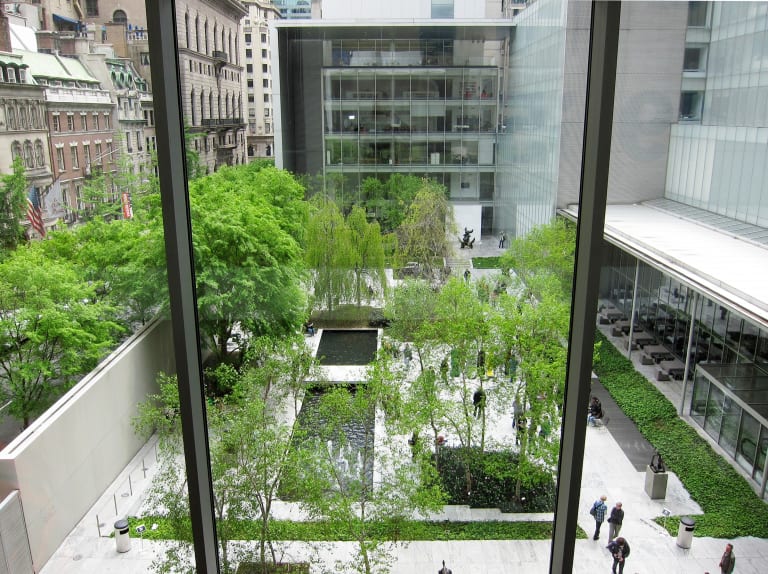
The MoMa collection is divided into six floors. Below is information about each of the floors, but I'll tell you in advance that floors 2, 3, 4 and 5 house most of the collection.
- The first floor is used as a hall and is where you will find the reception, ticket office, restaurant, shop, sculpture garden, etc.
- The second floor focuses on the collection from 1980 to the present: special exhibitions, prints, illustrated books, audiovisual media. It also houses the shop and café.
- The third floor includes drawings, photography, architecture and design from various periods.
- The fourth floor is where you will find paintings and sculptures from 1940 to 1980: Andy Warhol, Jackson Pollock, Mark Rothko, Yayoi Kusama, Japer Johns, Robert Rauschenberg, Roy Lichtenstein, etc.
- The fifth floor houses paintings and sculptures from 1880 to 1940: Vincent Van Gogh, Pablo Picasso, Claude Monet, Paul Cézanne, Henri Matisse, Frida Kahlo, Piet Mondrian...
- The sixth floor is reserved for special exhibitions and also houses a shop.
Our recommendation is that if you book your ticket for the MoMa, you start your visit on the 4th and 5th floors, where the main works are located.
Interactive guide to MoMA
The MoMA ticket includes an interactive guide that suggests some themed itineraries, depending on the type of visitor (adult or child) and the time you have available. This tool makes the visit much easier if you have limited time.
Recommendations for seeing the best works at MoMA without the crowds
1- Buy your ticket in advance: MoMA receives a large number of visitors every day. It is important to book your ticket in advance to avoid long queues and wasting unnecessary time at the ticket office. The cheapest tickets for MoMA cost around €27 at Hellotickets and are the perfect option if you want to avoid wasting time at the ticket office.
2- Check the map: It is advisable to check the map before starting your visit to see which floor has the most works that interest you and start your tour in that area. You will enjoy it more if you see them at the beginning of your visit!
3- Go first thing in the morning: It is best to visit MoMa first thing in the morning so that you have as much time as possible to enjoy the collection at your leisure.