
More about: Naples in 5 Day: a guidebook for getting the most out of your visit
A 5-day trip is more than enough time to see and do everything Naples has to offer. Not only that, but you can also take the opportunity to go on a day trip and explore nearby places such as Pompeii or the Amalfi Coast, two destinations that offer a glimpse into the history and traditions of the region.
Naples is a city brimming with Roman ruins and a rich religious culture, reflected in its many churches. Of course, it’s also the perfect place to sample the finest Italian cuisine. That said, its streets can be narrow and even a bit chaotic, so I recommend following this itinerary to avoid getting lost and to see everything.
Day 1: Explore the historic centre of Naples
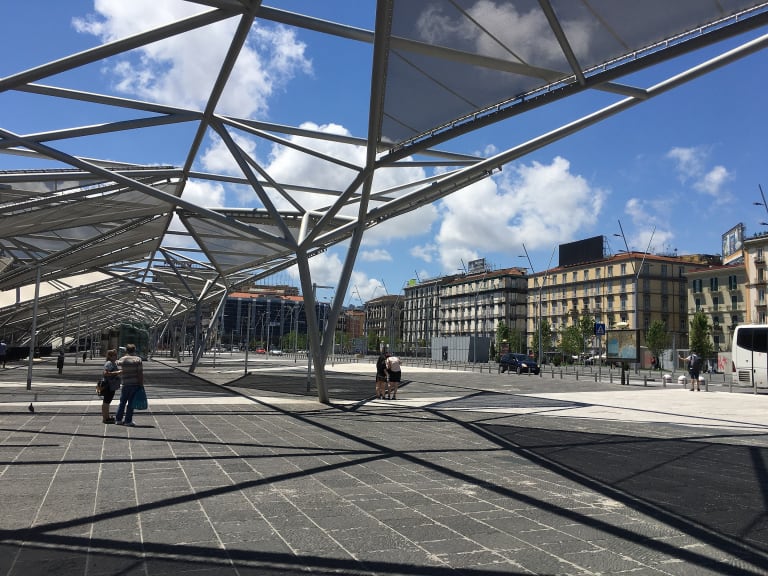
For your first day in Naples, I suggest you explore the old town and three religious buildings of great importance to the city: the Cathedral, the Basilica of Santa Maria Maggiore and the Chapel of San Salvador. Don’t worry, as you’ll also have time to wander through the streets.
Start the day in Piazza Garibaldi
Start your journey at Piazza Garibaldi, a very central location which is also home to the train station, several bus stops and the Line 1 metro station, making it very easy to reach, whether on foot or by public transport. It is a Renaissance-style square, although the vast majority of its buildings are modernist.
Unfortunately, the buildings in Piazza Garibaldi are private residences, so you’ll have to content yourself with taking a stroll and admiring their façades. Where you can get a bit closer, however, is to the food stalls scattered around the square. It’s a good place to buy something to eat if you haven’t had breakfast yet.
Piazza Garibaldi, like the other places I’m suggesting for today, is usually included in the :::link|text=guided tour of Naples:::, so if you’d like, you can sign up to learn all about the city’s history whilst you explore it.
Discover the treasures of Naples Cathedral
Leave Piazza Garibaldi behind and head along Via Umberto I towards Naples Cathedral, which is about a 15-minute walk away.
Its official name is the Metropolitan Cathedral of Santa Maria dell’Assunzione and it is one of the city’s great landmarks. It is also usually included in tours of Naples.
- Entry is free, although you’ll need to pay around €2 to visit the baptistery.
- Its façade is in the Neo-Gothic style.
- Its interior is far more intriguing, as it blends Baroque, Neo-Gothic and Gothic elements.
- Don’t leave without visiting the treasure it holds: dozens of silver statuettes and vials containing the blood of Saint Januarius.
Take a stroll and enjoy the best pizza in Naples on Via Tribunali

After leaving Naples Cathedral, it might be time to stop for a bite to eat. Just two minutes away is Via Tribunali, one of the city’s main thoroughfares.
There you’ll find several top-quality pizzerias, such as Di Matteo, which is said to serve the best pizza in the world (and sells slices for around €1).
If you don’t fancy pizza, you can pop into any other restaurant and try other typical Neapolitan dishes, such as arancini, which are delicious rice balls. But the best way to make sure you don’t miss out on any of the exquisite dishes is to go on a food tour – I highly recommend it for lunchtime!
Admire the historic architecture of the Basilica di Santa Maria Maggiore alla Pietrasanta
At the end of Via Tribunali stands the Basilica of Santa Maria Maggiore alla Pietrasanta, which was built on the site of an ancient temple dedicated to the Greek goddess Diana. Not only are there classical ruins, but its architecture also tells the story and evolution of the city. Entry is free and you can also climb the brick bell tower.
Apparently, the area adjacent to where the Basilica now stands was constantly haunted by the Devil, so the bishop of Naples in the 6th century decided to erect this building as a form of protection. Over the years, the structure suffered damage and had to be rebuilt in 1656.
End the day at the Chapel of San Severo
Next to the Basilica of Santa Maria Maggiore lies one of Naples’ great treasures: the Chapel of San Severo.
- Admission costs approximately €8.
- It houses the famous Veiled Christ, the renowned sculpture by Giuseppe Sanmartino.
- You’ll be able to see two human bodies up close, as there are two skeletons in the basement that perfectly preserve the circulatory system.
Day 2: Stroll through the streets of Naples

Believe it or not, there are still a few things left to see in the centre of Naples, although I’ve put together a slightly different itinerary for the second day. In the morning, you can spend some time exploring the interiors of a couple of religious buildings, but in the afternoon I recommend taking a stroll to discover the charms of Naples’ streets and squares.
If you don’t fancy another guided tour, you can opt for a sightseeing bus to make your journey easier and explore the city in comfort.
Visit the Church of Gesù Nuovo
Right in the heart of Naples stands the Church of Gesù Nuovo, situated in the square of the same name.
The building was constructed in the late 16th century and is notable for its Renaissance-style stone façade, although its interior is Baroque and quite opulent. The best part is that you don’t have to pay to admire its beauty, as entry is free.
Did you know that the Church of Jesús Nuevo was originally intended to be a palace? That explains why its exterior is so different from that of any other religious building. However, it ended up becoming a church, which is why the interior is so richly decorated with frescoes, marble features, domes…
Discover the Basilica of Santa Chiara
Right opposite the Church of Gesù Nuovo is the Monastery of Santa Clara, one of Naples’ major churches. Built in the Gothic style, its sheer size and its artistic and historical value make it one of the city’s most visited sites.
- Entry is free.
- Entry to the Great Cloister costs approximately €6.
- You’ll find a museum tracing the history of Naples.
- There are archaeological remains of the Roman baths that once stood there.
Stop off in the Spanish Quarter for lunch
When you leave the Monastery of Santa Clara, take Via Toledo, one of the city’s main thoroughfares, to head to the Quartieri Spagnoli (the Spanish Quarter), which is less than a 15-minute walk away. Where does the name come from? Naples was part of Spain on three separate occasions, so this neighbourhood is a legacy and testament to the close relationship the two places have shared.
The streets exude a very lively, local atmosphere, perfect for sampling the traditional fare, which I also recommend trying on a food tour of Naples. If you’re not sure how to fit it in, I suggest doing it at lunchtime so you can make the most of it.
Once you’ve filled your stomach, I recommend continuing your walk through the narrow, cosy streets of the Spanish Quarter. In particular, I encourage you to visit the Galleria Umberto I, a glass and metal structure housing various shops, and the Castel Nuovo, a castle that served as the residence of various kings when Naples was under Spanish rule.
Discover Piazza del Plebiscito and its historic buildings

A 5-minute walk from the Galleria Umberto I and Castel Nuovo is Piazza del Plebiscito, home to the city’s historic buildings such as the Basilica of Saint Francis of Paola (free entry) and the Royal Palace (approx. €6).
Although visiting the buildings is an option, you can also simply take a stroll around the square and see if you can pass the test that Queen Margaret used to set for some prisoners to grant them their freedom. Apparently, she would place them in the middle of the square, blindfold them, spin them round a few times and challenge them to walk in a straight line and pass between the two statues in the square. It sounds easier than it is – let me know how you get on if you give it a go!
Or you could simply have a drink nearby, as it’s a lovely spot to sit and relax whilst taking in the view.
Watch the sunset over Naples from the Castel dell’Ovo
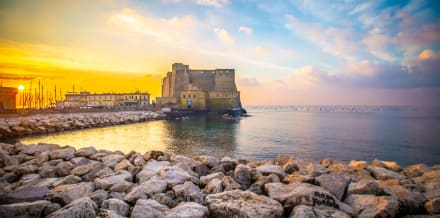
Before the day draws to a close, head to the Castle of the Egg (or Castell dell’Ovo). It’s about a 15-minute walk from Piazza del Plebiscito, situated on a small islet. Thanks to its strategic position, it served as the city’s main fortification and defence against attacks. Today it’s a cultural centre that you can visit for free.
Wondering where that strange name comes from? Legend has it that the poet Virgil hid an egg beneath its foundations which, if broken, would bring misfortune upon the city. I don’t know if this is true, but what I can assure you is that, from the fortress, there are stunning views of the Bay of Naples (and Vesuvius in the distance), especially at sunset.
Day 3: Discover Underground Naples

Your third day in Naples is packed with history, and there’s no better place to experience it than the Archaeological Museum. After spending most of the morning there, I’d encourage you to head back to the city centre for a bite to eat and continue exploring the city’s history, though this time underground.
Start the day at the Archaeological Museum of Naples
Start your second day with a visit to the Archaeological Museum of Naples. Although it’s about a 15-minute walk from the centre, right on Piazza Cavour, you might find it more convenient to get there by public transport (metro line 1 or line 2).
It’s one of the best museums in Naples, so I recommend buying a ticket and seeing its collections of great historical value.
There are four floors in total and the most interesting, at least for me, is the area dedicated to sculptures and artefacts from the Roman era. The remains recovered from the ashes of Pompeii are particularly striking.
Take the opportunity to do some shopping at the Galleria Principe di Napoli
You might well spend a whole morning visiting the museum, but before heading into the city centre for lunch, I recommend stopping off at the Galleria Principe di Napoli, which is just a 5-minute walk from the museum. Entry is free, though you can make the most of it by doing a bit of shopping.
The history of the Galleria Principe di Napoli is somewhat tragic, as it has never been particularly well maintained. In fact, as early as the beginning of the 20th century, the Neapolitans were calling for the building to be restored, though this didn’t happen until well into the 21st century. Now its brick structure and glass roof are much more stable, and it hosts concerts and leisure activities.
Take a food tour of Spaccanapoli
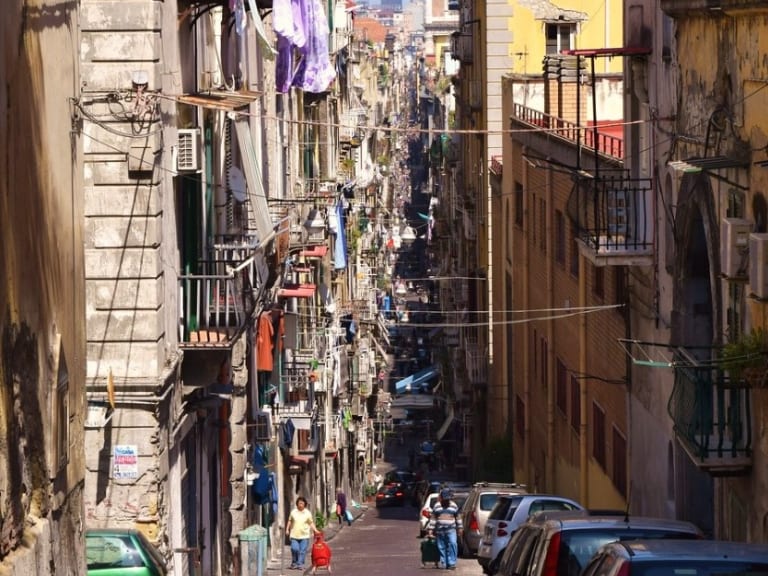
After all that history, you might be feeling peckish. The Spaccanapoli area is one of the best places to eat. Walk down Via San Sebastiano from the Galleria Principe di Napoli towards Benedetto Croce, the first section of this street. Once there, I recommend taking a food tour of Naples.
For around €30, you’ll enjoy the best local cuisine (beyond just pizzas) whilst a guide tells you about the city’s history.
The great thing about these tours is that you’re guaranteed to visit the best places and know exactly what to order. Spaccanapoli is one of the most important areas in the city centre, although it could be said that it actually consists of several streets.
Head underground on a tour of Underground Naples
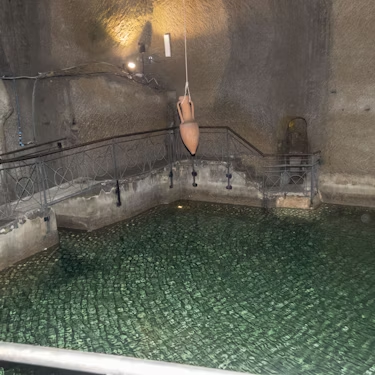
Can you imagine exploring a city through its underground? Get your tickets to visit Underground Naples and find out (they cost around €10). This network of tunnels (the largest in Europe) is a 15-minute walk from the Spaccanapoli area.
It’s a unique experience where you’ll discover these passageways which, originally during the Greek era, were water reservoirs.
Under the Romans, their use changed and these underground tunnels became sites for quarrying rock. Centuries passed and then came the Second World War, when they served as shelters during the bombings, saving thousands of lives. Today you can visit them, explore them and discover the underbelly of Naples. Be warned, they’re not for you if you suffer from claustrophobia!
Discover the ruins of the Greco-Roman Theatre in Naples
When you leave Underground Naples, you’ll emerge via the Greco-Roman Theatre, which rises from beneath a private home. The site visible today is Roman, though there are also remains of the earlier, Greek-origin structure.
The visit is included in your Underground Naples ticket, and what is most impressive about the Greco-Roman Theatre (apart from the fact that it lies beneath a house) is its marble, which adorns the entire site.
It is also known as the place where Nero performed many of his plays and where, according to legend, he did not interrupt his performance even during an earthquake.
Day 4: Discover the ruins of Pompeii and climb Mount Vesuvius

Very close to Naples, just half an hour away, lies Pompeii, an ancient town that was devastated yet preserved by the eruption of Mount Vesuvius.
This is an unmissable visit, so for your third day I recommend booking a tour from Naples to Pompeii and Mount Vesuvius, the city frozen in time. These tours not only include transport and admission, but also commentary from a specialist guide.
Pompeii Archaeological Site
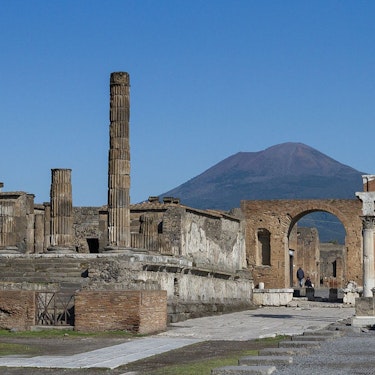
Buying tickets for Pompeii and visiting it is like stepping back in time some 2,000 years. I know it seems impossible, but consider that the lava and ash that covered this city managed to preserve buildings, objects and even bodies for years, specifically since 79 AD, when Vesuvius erupted.
There is plenty to see and do in Pompeii. It is quite a large area, so be prepared for a good walk.
This city was prosperous and wealthy, although nature was never on its side (a few years before the volcanic eruption, it suffered a severe earthquake). During your visit, you’ll be able to see this for yourself and explore such incredible sites as the ancient Forum, the Temple of Apollo or the villas of the Roman nobility. Everything remains almost intact, so you’ll be able to get a fairly accurate idea of what life was like there.
Have a bite to eat after finishing your visit to Pompeii
You’ll need at least the whole morning to explore the ruins of this Roman city. When you’re done, I recommend heading out of the site to fill your stomach. You might think that, as it’s a tourist spot, nothing’s worth it and it’s better to bring a sandwich, but there are some excellent restaurants to eat at in the area around Pompeii.
Pizza, pasta, tapas and Mediterranean set menus… You’re spoilt for choice. In the streets surrounding the archaeological site, there are plenty of places where you can eat well for around €25 per person. Once you’ve finished, it’s time to continue your visit and meet the ‘culprit’ responsible for Pompeii’s destruction: Mount Vesuvius.
Climb Mount Vesuvius and take a close look at its crater

The second part of the excursion involves visiting Vesuvius. If you’re on an organised tour, you’ll travel by private coach. Otherwise, you’ll need to take the EAV bus (around €3 each way).
In any case, you’ll then have to walk the rest of the way and pay the entrance fee to the summit, which costs around €10, unless it’s included in your tour.
Vesuvius is one of the world’s most dangerous volcanoes, but don’t worry – it hasn’t been active since the 1940s. It’s well worth the climb to see its craters and plumes of smoke up close. What’s more, at over 1, 200 metres high, the views of Naples are quite incredible.
Discover the area around Pompeii
Since you’re in the area, once you’ve come down from Vesuvius, I recommend staying on to explore the surroundings of Pompeii. It’s a beautiful area with plenty of nature – you won’t want to miss it! One of my favourite places is Herculaneum, a town also buried by Vesuvius’s lava.
Although not as well-known as Pompeii, Herculaneum is also very well preserved. I recommend taking a stroll around it because, what’s more, it’s usually less crowded. There you can find the remains of Roman baths and the ancient homes of those who once lived there.
If you’d also like to explore this area in depth, I recommend booking a tour of Pompeii that includes Herculaneum. It isn’t usually as popular because it’s less well-known, but it’s also well worth a visit.
Day 5: Take a trip along the Amalfi Coast
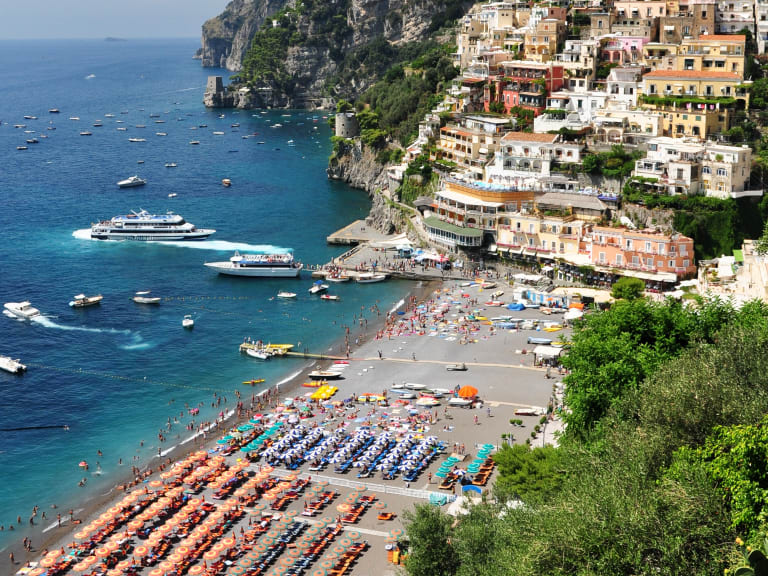
I’m sure that whilst in Naples you’ve already noticed how beautiful the bay area is. However, to really enjoy picture-perfect beaches and traditional villages perched on rocky cliffs, there’s nothing quite like taking a trip to Sorrento and the Amalfi Coast from Naples.
The best way to get around is to join an organised tour that includes transport, so you don’t have to worry about a thing, although you can also hire a car or travel by bus and train. Let me tell you what your itinerary could be.
Start the excursion in Sorrento
Start your journey along the Amalfi Coast in Sorrento, one of the most iconic towns in the area.
- Climb up to the city walls for a panoramic view of the Tyrrhenian Sea and the Bay of Naples.
- Head to the historic centre of Sorrento, with its narrow, medieval-style streets.
- Visit its shops and restaurants, particularly in Piazza Tasso, the heart of the town.
- Nearby is the Vallone dei Mulini, an area that has been uninhabited since 1940 and is therefore like a vast wild forest in the middle of the town.
Continue the journey to Positano
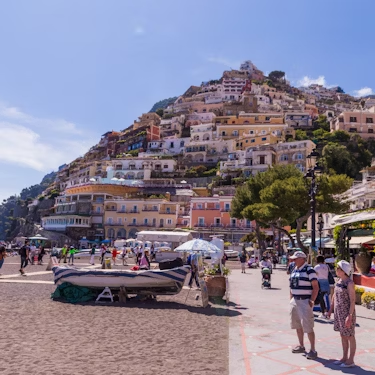
Just a 40-minute drive away is Positano, your next destination and also that of many other tourists, as it is one of the most visited towns on the Amalfi Coast. It’s no wonder, really, as its colourful houses and the lush greenery that blankets the whole town give it a distinctive and truly beautiful appearance.
The only downside to Positano is that there are lots of steps, so be prepared to go up and down them many times. However, it will be well worth it because that means you’ll get to see such beautiful places as the Church of Santa Maria Assunta and its famous dome, or its beaches.
Make the most of eating on the beaches of Positano
After taking a dip at one of Positano’s beaches, what could be better than grabbing a bite to eat? Although prices can be a bit steep, being right by the sea has its perks: the freshest fish you could imagine. I recommend trying the pasta with clams or a good seafood platter.
When you’ve finished, before continuing your journey, you can take a stroll along the sand or lie back and rest for a while in the sun loungers that are usually available on any of the beaches. Bear in mind, though, that in high season you’ll struggle to find one free.
Discover the history of Amalfi
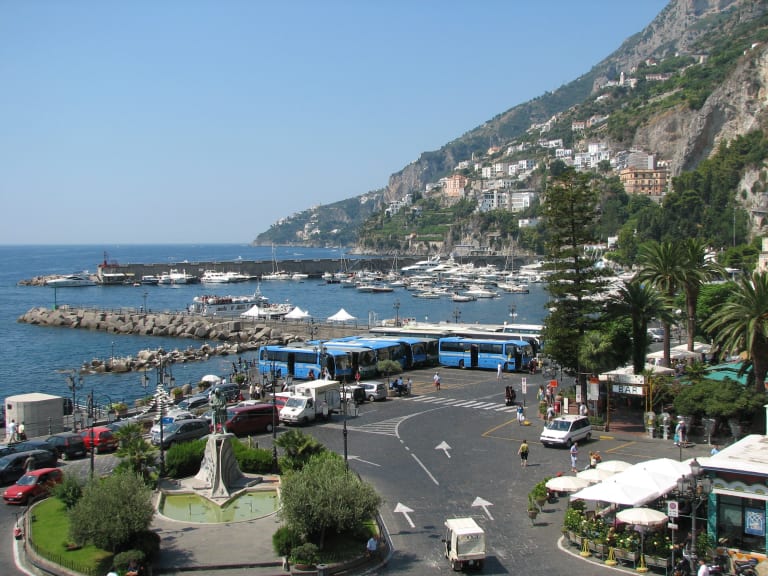
Your next stop, just over half an hour by bus from Positano, is Amalfi. As you might guess, history runs through its streets and, what’s more, this is where you’ll find one of the area’s great landmarks: its Duomo.
Amalfi Cathedral , or Duomo, is one of those places you simply must visit. Entry costs around €3 and allows you to see the entire complex, which is actually two interconnected churches and, amongst other rooms, the famous Cloister of Paradise. Built with marble columns and Arabesque arches, it houses the sarcophagi of the town’s illustrious figures.
End the day in Ravello and head up to its viewpoint
Before heading back to Naples, I recommend making one last stop in Ravello, the final village on the Amalfi Coast. It may not be as well-known as the previous towns, but it has its own charm. So much so that for years it has been a destination for artists of all kinds, who came there to relax.
As well as strolling through its streets and having a drink on one of its terraces, the great thing about ending your trip in Ravello is that it makes for the perfect farewell. To do so, head to Villa Rufolo, a former noble residence that is now a cultural centre and also a viewpoint from which to take in the whole of the Amalfi Coast.
The best way to get around Naples

Naples is a city where locals usually travel by car. However, as a tourist, it’s best to walk; distances within the historic centre are generally short.
If your hotel is a bit further away, you can buy single tickets for public transport (around €1.10), day passes (around €4.50) or weekly passes (around €16).
The only situation in which it might be worth renting a car in Naples is if you plan to make several trips. The daily rate is around €30, but bear in mind that driving and parking in Naples is tricky and somewhat chaotic.
Got everything sorted? Make a note of the places you want to visit and follow this itinerary so you don’t miss a thing and can enjoy Naples to the full.