






More about: Via Appia Tours in Rome
It is estimated that Rome’s Via Appia is around 2,300 years old. It was designed in 318 BC by the Roman consul Appius Claudius Caecus, with the aim of connecting Rome with Capua. Later on, it was extended as far as the present-day city of Brindisi, and from there Rome was connected via the Via Appia to Greece, Egypt and the East, facilitating military and commercial expeditions.
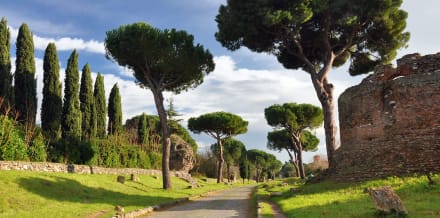
Today, you can explore Rome’s Via Appia on foot or by bicycle. It is a wonderful, peaceful walk with plenty of history to discover. It is a journey to be taken at a leisurely pace, admiring the landscapes and monuments that unfold along the sides of the Via Appia. There are many things to see and do in Rome, and exploring the Via Appia on a tour is one of the best.
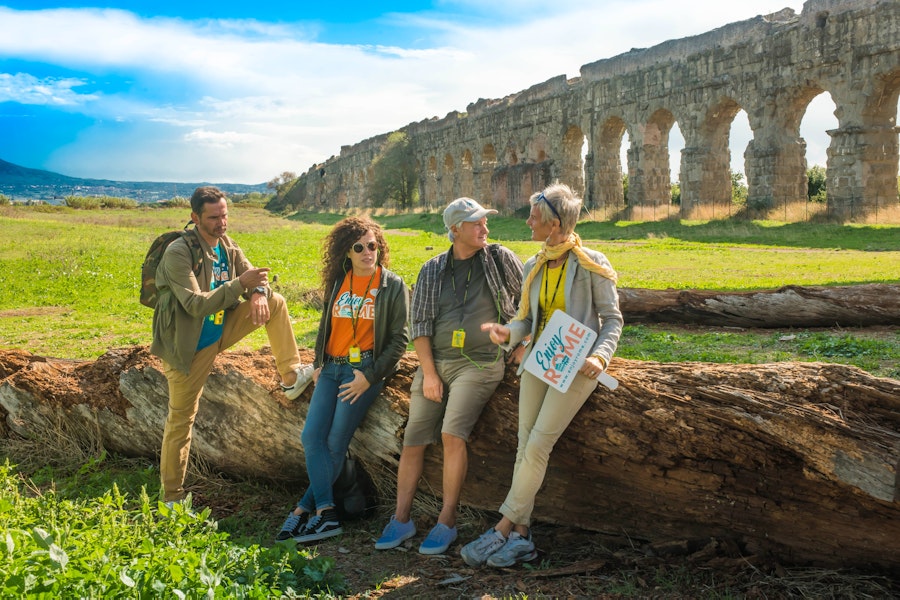
Appian Way and San Callixtus Catacombs Guided Tour
Explore the Via Appia and the Catacombs on a historical tour from Rome
Walk along one of Rome’s oldest roads and explore the Catacombs of Saint Callixtus on this 3-hour guided tour. The tour includes coach transport and a professional guide.
This guided tour of the Via Appia and the Catacombs of Saint Callixtus is ideal for those who wish to discover the oldest and most enigmatic Rome. Over the course of around 3 hours, you’ll explore key sites in the Roman countryside with a guide, from the Circus of Maxentius to the Mausoleum of Cecilia Metella, as well as visiting the interior of the city’s most famous catacombs.
The tour includes a coach transfer from central Rome, admission tickets, headphones and an expert guide. A perfect way to get away from the urban hustle and bustle and delve into the city’s Christian and Roman past.
Recommended if... you’re interested in ancient history and are looking for a comfortable, guided tour off the beaten track of central Rome.

Rome Ancient Appian Way, Aqueducts and Catacombs E-Bike Tour
A tour of the Via Appia and the Roman aqueducts by electric bike
Explore 27 km of history along the Via Apia on an active e-bike tour. Enjoy the countryside, see Roman ruins and, if you choose the longer route, visit the Catacombs of Saint Callixtus too.
This e-bike tour along the Via Appia allows you to enjoy Rome’s most natural and ancient side in an active yet effortless way. During the tour, you’ll cycle past ancient ruins, aqueducts, the Circus of Maxentius and sites such as Porta San Sebastiano, all accompanied by a professional guide in small groups.
You can choose between a 4-hour tour or a more comprehensive 6-hour tour that also includes a guided visit inside the Catacombs of San Calixto. A perfect option for those who want history, nature and physical activity without any hassle.
Recommended if... you prefer to explore Rome actively and enjoy the great outdoors whilst discovering impressive archaeological remains.
Types and prices of guided tours of the Via Appia in Rome

There are several options for guided tours of Rome ’s Via Appia, and a guided tour is definitely well worth it. You can choose to do the tour on foot or by bike. Bike tours can be private or group tours and are usually on electric bikes.
You can opt for standard bikes, but bear in mind that it’s a long distance and you need to be very used to cycling to cope with such a long journey.
Prices range from 50 to 95 euros depending on the duration of the tour and whether it is private or group-based. These tours last between 4 and 5 hours and include insurance (you should check what cover is available).
You also have the option of choosing a tour that, in addition to the Via Appia, includes other attractions. In this case, you can opt for a private tour by car, with a guide and driver, for approximately 170 euros.
The advantage of these tours is that admission fees are usually included in the price, and you also get priority access, so you don’t have to queue. By avoiding the queues, you save a lot of time to enjoy the activities. This is undoubtedly one of the best tours of Rome.
The start of the tour of Rome’s Via Appia at the Porta San Sebastiano

The tour of the Appian Way begins at the Porta San Sebastiano in Rome. Also known as the Porta Appia, it is the largest of the structures forming part of the Aurelian Walls.
Fortunately, it is in an excellent state of preservation. The Museum of the Walls is currently located at the Porta San Sebastiano and is well worth a visit.
Please note that you must pay an entrance fee to enter the Museum of the Walls and queues can sometimes be long. The museum is divided into three sections: ancient, medieval and modern, showcasing the different stages of the city’s fortifications in an interactive and educational way.
If you have a particular interest in architecture, you’ll really enjoy this museum, as it’s very well organised and the information provided to visitors, along with the educational resources available, is excellent.
From here, the tour continues along Rome’s Via Appia until reaching the second point of interest, the Church of Quo Vadis.
Next stop on the tour: The Church of Domine Quo Vadis
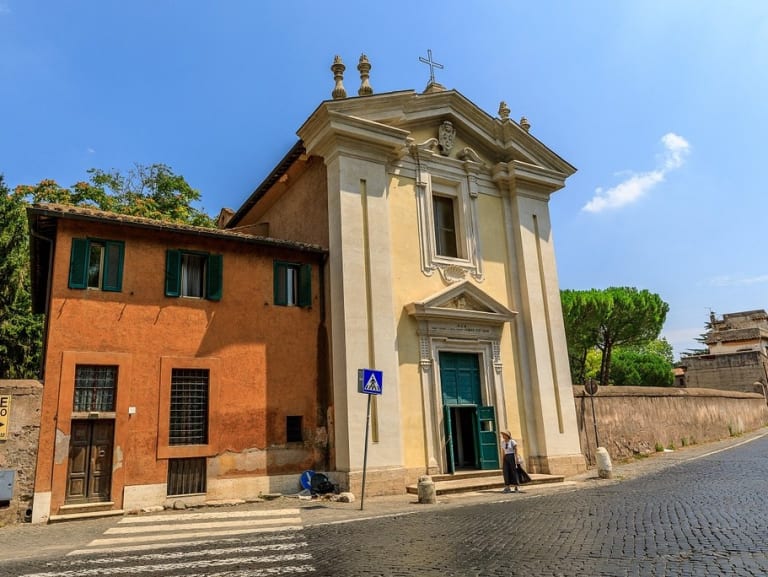
Following the route of Rome’s Via Appia, you arrive at the Church of Domine Quo Vadis. It is believed that, in this church, Jesus, already dead, appeared to Peter whilst he was trying to flee from the crucifixion. Faced with this apparition, Peter is said to have returned to Rome to accept his martyrdom and die by crucifixion.
The Church of Domine Quo Vadis was built in the 17th century on the site of a small chapel dating from the 9th century, and there are beautiful frescoes to admire inside.
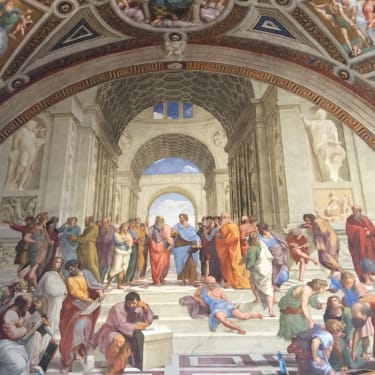
The frescoes depict the Crucifixion of Christ and the martyrdom of Saint Peter. If you’re a fan of religious tourism, you can also visit the Sistine Chapel, one of Rome’s must-see attractions.
Are the Catacombs of Saint Callixtus included in the guided tours of the Via Appia?

Yes, the guided tour of the Via Appia also includes the Catacombs of Saint Callixtus. However, to visit them on the bike tour, you’ll need to book the 6-hour tour option.
Along Rome’s Via Appia, you’ll find numerous tombs and catacombs, as it was once forbidden to bury the dead within the city walls. One such burial site is the Catacombs of Saint Callixtus, which contain over 170,000 tombs—the best-preserved along the entire Via Appia—and a visit is included in the walking tour.
It is a highly recommended visit, as there are numerous tombs of Christian martyrs and saints. If cemeteries put you off, you might want to give this activity a miss.
Next stops on the guided tours of Rome’s Via Appia

The Basilica of Saint Sebastian
A little further on from the Catacombs of Saint Callixtus (San Callisto) lies the Basilica of Saint Sebastian. This Basilica also houses a vast complex of catacombs, accessed via a staircase in the right-hand aisle of the Basilica.
The Catacombs of Saint Sebastian became a Christian burial site in the late 2nd century AD. Previously, they had been used as a pagan cemetery.
Remember that there are tickets available to skip the queues. They cost a little more, but it’s worth paying the extra if you save hours of time by skipping Rome’s longest queues. If you’re staying in Rome for a few days, you can also visit the Vatican Catacombs.
About 200 metres ahead of the Catacombs of Saint Sebastian, you’ll find the next stop: the ruins of Villa di Massenzio.
The Ruins of Villa di Massenzio on the Via Appia in Rome

The ruins of Villa di Massenzio on the Via Appia in Rome consist of three main buildings: the circus, the palace and the mausoleum. It is a very interesting architectural complex well worth a visit.
The dynastic mausoleum is also known as the tomb of Romulus, as it is believed he was buried there. Whether or not the story of Romulus’s burial here is true, it is a magnificent monument and, together with the other two structures, forms a harmonious complex of understated, timeless beauty.
Immediately after passing the Tomb of Romulus, you will reach the sixth stop on the tour of Rome’s Via Appia: the Mausoleum of Cecilia Metella.
The Mausoleum of Cecilia Metella on the Appian Way in Rome

When you reach this point, you will see one of the most iconic mausoleums of the Roman era. The Mausoleum of Cecilia Metella is one of the most impressive funerary monuments in Rome. This enormous and beautiful structure served as the tomb of Cecilia Metella, daughter of the consul Quintus Metellus, conqueror of Crete.
The Mausoleum of Cecilia Metella was incorporated into the castle by the Caetani family as the main tower and has retained its imposing appearance to this day.
Continue walking and after a few minutes you will find, on your right, the seventh point of interest on the Via Appia tour in Rome: the ruins of the Frontespizio and, a little further on, the medieval farm of Santa Maria Nova and the pyramidal tomb.
The ruins of the Frontespizio on the Via Appia in Rome, the medieval farm of Santa Maria Nova and the pyramidal tomb

These three monuments are situated within a short distance of one another, so it won’t take you long to visit them. The ruins of the Frontespizio are a small, well-preserved site. They are believed to date from around the 1st century BC. A few metres further on is the medieval farm of Santa Maria Nova.
Continue walking a few metres and you will see a pyramid-shaped structure ahead, about which little is known at present; however, due to the large size of the tomb, there has been much speculation regarding its owner, though none of the theories has been confirmed.
Continuing along the Via Appia in Rome, about 100 metres further on, you will find the eighth stop, consisting of the so-called Tumuli degli Orazi, and 150 metres from this, you will see the Villa dei Quintili.
Tumuli degli Orazi and Villa dei Quintili on the Via Appia in Rome

The Tumuli degli Orazi funerary complex consists of two tombs similar to the Etruscan tombs found in the Banditaccia necropolis. It is believed that they may date from the 2nd to 3rd century BC.
Although many theories have been put forward regarding these tombs, the only thing that has been confirmed so far is that one of them is empty and there is no clear evidence as to who might have been buried there.
In contrast to the austerity of the Tumuli degli Orazi, 150 metres further on you will find the Villa dei Quintili. This is a magnificent residential complex, the largest in the suburbs of Rome.
The Villa of the Quintili belonged to the Quintilius brothers, Roman consuls in 151 AD.
The brothers were executed for alleged treason and conspiracy on the orders of Emperor Commodus, and the Villa was confiscated. Following the execution of the Quintilius brothers, the Villa continued to be used as a residence by several Roman emperors, including Commodus.
Continuing along the route, you will reach the ninth stop, the Casal Rotondo.
The Casal Rotondo

Casal Rotondo is the largest circular mausoleum on Rome’s Via Appia and one of the largest in Europe. This enormous mausoleum was once clad in travertine marble and is believed to have been built around the 1st century BC.
Unfortunately, despite the many studies that have been carried out, little more is known about its construction, origins and original owners.
Some time ago, a fragmentary inscription bearing the name Cotta was found. This discovery has led the archaeologist Luigi Canina to believe that it is a funerary monument erected by Messalino Cotta, son of the consul Messalla Corvinus, a lawyer and man of letters from the time of Augustus, but this theory has not been confirmed.
Whoever the owner may have been, there is no doubt that this is a magnificent monument, and the Casal Rotondo is one of my favourite stops on the Via Appia in Rome.
A few metres away lies the tenth and final stop on the tour of the Via Appia in Rome: the Torre Selce.
The Torre Selce

It is believed that, in the 12th century, the Astalli family used the foundations of an ancient Roman tomb as the base for a huge tower known today as the Torre Selce. It is situated on the Via Appia, almost at the end of the tour.
During the Middle Ages, Rome’s ancient monuments suffered severe deterioration as they were used as quarries, providing people with cheap bricks and stone.
Over the centuries, the monuments along the Via Appia were successively plundered, losing most of their riches. The Selce Tower did not escape this fate and, in addition to the natural deterioration caused by the passage of time, successive looting has robbed it of the splendour it must have possessed in its day.
If you look into the distance, you can see the aqueduct that supplied the Villa of the Quintili. The view is magnificent; it is an extraordinary feat of engineering and of exceptional beauty.
Is it possible to walk the Via Appia with children?

Walking the Via Appia in Rome is a wonderful experience, but it involves many hours of walking. Walking this far with young children is not recommended if they are not used to it. If you wish to do so, bring a pushchair to help the little ones when they get very tired.
Don’t forget to bring water and snacks for the little ones. Don’t forget hats and sun cream either.
Walking the Via Appia with children can be easier outside the hottest and coldest months. If you’re travelling to Rome with children, take the weather into account when planning your trip; try to visit during the best time of year to travel to Rome.
Tips for a tour of Rome’s Via Appia

- As this is a long walk, remember to stay hydrated (take a few bottles of water with you), wear comfortable clothing (sportswear is even better) and suitable footwear (avoid sandals and don’t even think about wearing heels).
- The best thing to do is to book tickets in advance for the attractions along the Via Appia you wish to visit, to save time during your trip and ensure tickets are available. Always opt for priority tickets; queuing in Rome can be a real chore.
- Plan your trip in advance and make sure you book your tickets, at least for the main attractions, well in advance.
- If this is your first trip to Rome, try to plan your itineraries with extra time in case of unforeseen events. The key to a successful trip lies in advance planning.
- Bear these 10 tips in mind when organising your trip to Rome and you’ll find you save a lot of time when planning your visit.